Have you ever imagined that the computers of the future might rely not on electrons, but on photons? During SCIE Science Week, Dr. Liu Junqiu led us into the forefront of this very field—integrated photonics.
Dr. Liu Junqiu is a researcher at the China Quantum Research Institute, concurrently serving as an associate editor for the American Physical Society Journal Phys. Rev. Applied and as a researcher at the Hefei National Laboratory for Quantum Science and Technology. His accolades include the European Physical Society’s Fresnel Prize, among other prestigious awards, reflecting his broad research interests and deep enthusiasm. Amid the serene academic environment of the Swiss Federal Institute of Technology in Lausanne (EPFL), he earned his doctoral degree and subsequently pursued postdoctoral research.
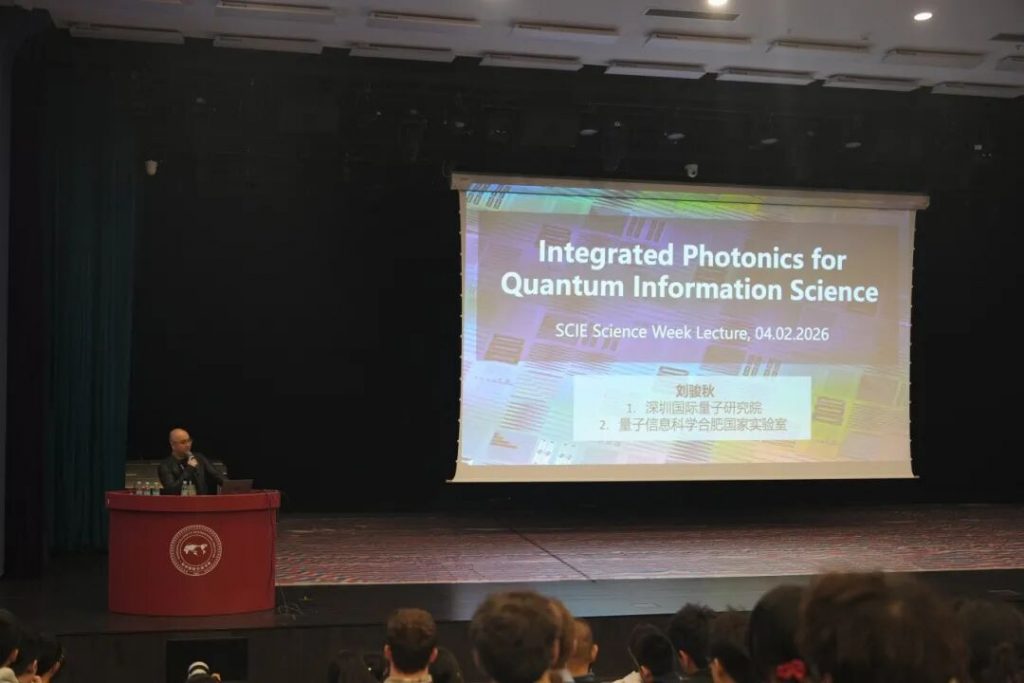
Dr. Liu explained that photonic integrated circuits are fabricated using standard semiconductor CMOS processes—a production method that requires expensive, precision instruments and operates under stringent environmental conditions. These circuits consist of components measuring merely a few hundred nanometers, designed to transmit optical signals. It is precisely this nanoscale architecture that enables them to overcome the performance bottlenecks of traditional circuits in signal processing, achieving higher capacity, faster speeds, and significantly lower energy consumption.
Going further, Dr. Liu challenged our conventional understanding of digital and optical signals. Typically, optical signals are viewed as carriers of information that must first be converted into electrical signals for processing. In contrast, his research explores direct optical signal processing and analysis. He firmly believes this shift represents an overarching trend in the field—one that will inevitably spark profound transformations.
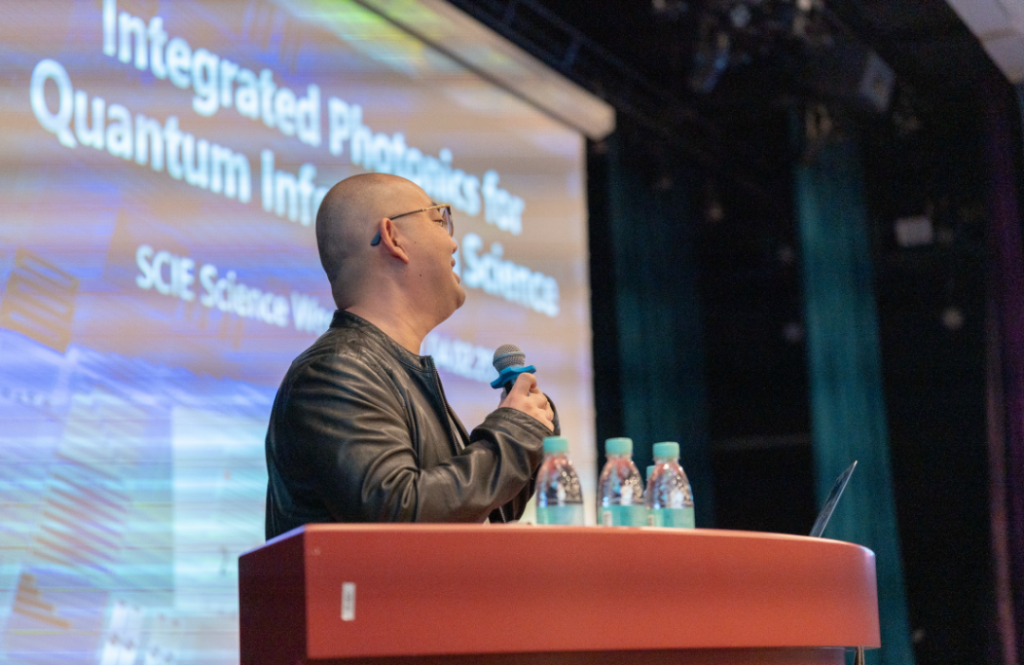
Dr. Liu then shared the major applications of integrated photonics, its societal and national impact, and its commercialization prospects. Among the diverse applications of optical integrated circuits, he highlighted a key project he and his team are advancing: cosmic spectroscopy observation. In this project, integrated photonics is applied to astronomical observation. By analyzing the “characteristic emission spectra” of elements, researchers can determine the velocity at which observed celestial bodies are receding from Earth. The observation of the “cosmic redshift” phenomenon—familiar from physics textbooks—reveals hidden connections to the mysteries of quantum data research, breathing new life into theoretical knowledge.
Dr. Liu’s research plays a vital role in advancing national and societal development: it not only creates substantial employment opportunities but also holds significant value for achieving technological self-reliance and promoting domestic alternatives in high-end scientific instrumentation. Moreover, it tangibly embodies national strategies such as innovation-driven development and cultivating a strong talent pool.
In the concluding segment of the lecture, Dr. Liu outlined the commercialization prospects of integrated photonics, spanning fields such as metrology, LiDAR, quantum technology, aerospace, and healthcare. As we listened, it felt as though emerging technologies were infusing new vitality into global progress, with young scientists turning ambitious dreams into reality through dedication and innovation. This lecture not only offered us a glimpse into the future of quantum technology but also planted the seeds of scientific curiosity and exploration in every attendee’s heart.
- Article / Emma Zhao
- Pictures / Admissions