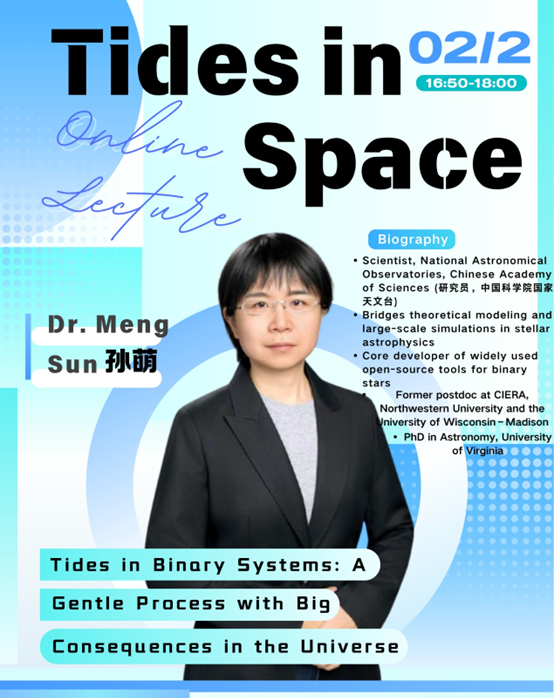
Once every year, SCIE holds a Science Week, but this year is special and “astronomical”! I have encountered many wonderful and kind professors, and it’s truly an honor to have one of these ‘North Stars of mankind’ here, giving an online lecture on stars themselves!
Dr. Sun is an associate professor at National Astronomical Observatories, Chinese Academy of Sciences who bridges theoretical modeling and large-scale simulations in stellar astrophysics, core developer of widely used open-source tools for binary stars such as POSYDON and MESA (we really need to thank these programmers breaking their backs backstage for our convenience), and a former postdoc at CIERA, Northwestern University and the University of Wisconsin–Madison. She actually received her PhD in Astronomy from the University of Virginia.
On Feb. 2, Dr. Sun discussed Tides in Space: A Gentle Process with Big Consequences in the Universe with us online. She began the lecture with her research topic – stellar tides and asteroseismology. She allowed us to break the stereotype in physics that stars aren’t rigid spheres but rather dynamic bubbles, like boiling water. She broadened our horizons by demonstrating that stars are also affected by tides from inside and outside.
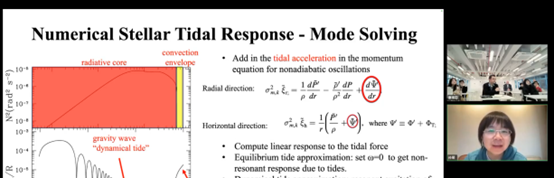
Dr. Sun also explained that tidal locking, one face of a planet always facing the star, is possible because of the millennia-long battle between the planet’s angular velocity and friction from the star’s pull.
After orbital smoothing (orbit of planet goes into a rounder circle), orbit decay (planet orbit closer to star), orbital synchronization(the slow locking of the planet’s side to the star) and axis alignment(the planet’s axis aligns parallel to star), a planet gets fully tidally locked to its star, one side forever in scorching daylight and another in eternal darkness.
Dr. Sun also showed us graphs from her research produced by her own developed code. The zigzagged graph is an electrocardiogram; each pulse is a spurt from the trillion-degrees-Celsius heart of the star billions of miles away. It is truly marvelous that through models and code, we can ‘listen’ to the spewing of ‘life’ from these ancient mammoths’ hearts.
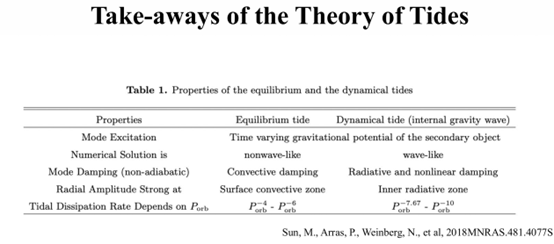
In fact, the mechanism of tides differs from the radiative and convection layers of stars, and temperature is a major factor. Dr. Sun humorously explained that she counterintuitively represents the hotter area in blue and the cooler in red because blue light is emitted by objects at higher temperatures. Hence, technically, blue is related to ‘hot’ rather than ‘cool’.
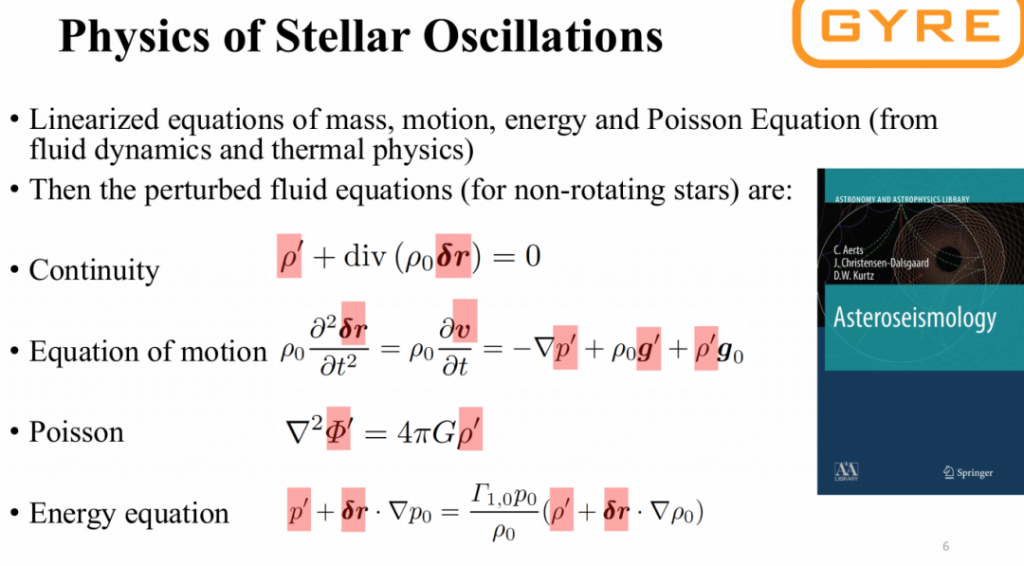
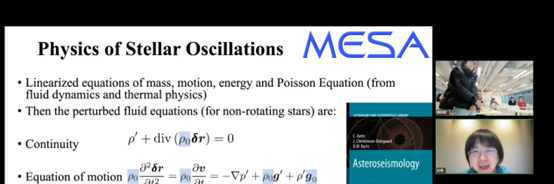
Finally, Dr. Sun draws our attention to extreme systems in the universe, such as neutron star binaries and exoplanets about to be engulfed by their stars (WASP 12b specifically). She walked us through the graphs and equations she deduced from MESA and GYRE, a useful software for stellar astrophysics. Through the compacted peaks and troughs slowly rising, we could deduce the mass, orbital period, and parameters of a compacted cosmic monstrocity without being there personally(which we’d have no way to anyway), which we could ‘go back in time’ and deduce the predecessor of the system before the neutron star was born.
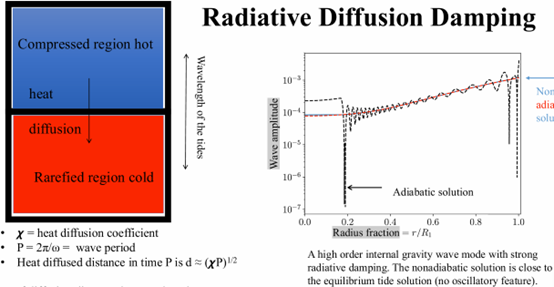
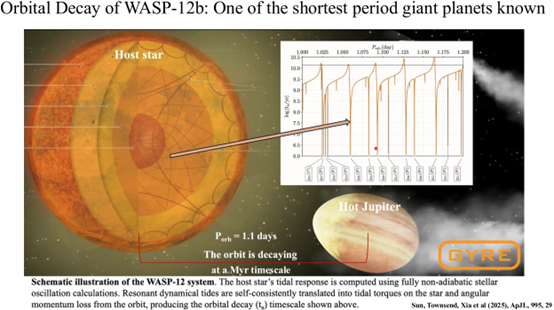
Through the seemingly periodic resonant dynamical tides of star WASP 12A, Dr. Sun points out that these tides foreshadow the tragedy of orbital decay of the planet WASP 12b, leading to its inevitable doom being swallowed by its host star.
However, Dr. Sun points out that the model has some fluctuations in matching exactly the observations, and that it might lead to a whole new theory on the composition of the stars in this binary and their evolution.
Science is a study of evolution, which, like a tree splitting into new branches, reinforces stronger, supported stems and withers outdated, unsupported twigs. In this illustrative example, Dr. Sun presents her research, bringing us a front-row seat to how astrophysicists like her are pioneers in exploring the boundaries of human understanding of the universe. “Modern pioneers don’t cultivate with silver and ships,” Dr. Sun stated, “but through innovation and research.”
After the lecture, students and faculty actively raised questions, all of which Dr. Sun answered patiently and in detail. She shared insights into future applications of stellar tides, offered practical guidance on using MESA to create your very own star on a PC (“Mac and Linux work best,” she noted), and provided advice on pursuing research in both observational and theoretical astrophysics.
Through the lecture, we learned what happens ‘behind the scenes’: the countless coding and testing of potential models before the ‘pretty space pictures’ or ‘tantalizing physics conclusions’ came out. In sum, Dr. Sun encourages us to become the first or second generation of scientists like Sir George Darwin, who contributed profoundly to stellar astrophysics and the son of the more famous Charles Darwin, to “stay hungry, stay curious, and keep our heads in the stars.”
- Article / Jiya Qin