As a theoretical subject, a common question students ask in math class is: “When will I use this knowledge in real life?” Although the math we learn in high school can rarely be used directly in our daily lives, it serves as a solid foundation for many scientific disciplines. New ideas in science and engineering often depend on existing math theories, and Euclidean geometry is a perfect example of this; mathematicians have long been ahead of their time, exploring the geometry of multi-dimensional and non-flat spaces, which laid a strong theoretical foundation for later scientific and engineering research.
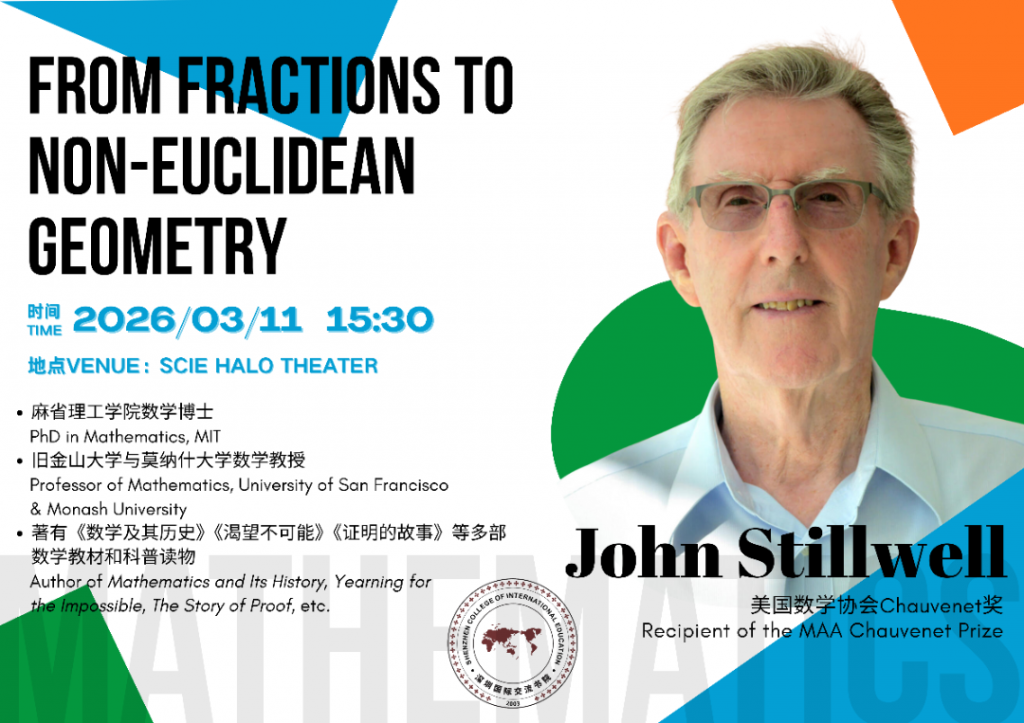
On March 11, 2026, the renowned mathematician Prof. John Stillwell visited SCIE and gave a wonderful talk on non-Euclidean geometry. The professor explained the patterns of non-Euclidean geometry from a pure math perspective, and cleverly connected mathematical theories to physics research, helping students on site to see clearly the key role math plays in the development of science.
Prof. Stillwell received a Ph.D. from MIT in 1970, taught at Monash University until becoming a mathematics professor at the University of San Francisco in 2002. He received the Chauvenet Prize from the Mathematical Association of America in 2005, recognising his excellence in mathematical exposition.

Starting with the most basic knowledge about fractions, Prof. Stillwell guided everyone to uncover the geometric secrets hidden behind simple numbers. He first showed the reduced fractions between 0 and 1, which because of prime numbers are not arranged in a regular pattern. Then he shared a classic discovery made by Farey in 1816 that surprised everyone: when you put these fractions in order of size, each fraction is exactly the “mediant” of its two neighbours. By using the “silly sum” of adding numerators and denominators separately, you can correctly find the middle fraction. This strange way of calculating actually reveals a deep connection between fractions.
To visualise this number theory, professor introduced the idea of Ford circles. Starting with unit circles placed at 0 and 1 on the real number line, then repeatedly adding circles in the gaps that touch both of their neighbours, each new circle’s point of contact with the number line matches exactly with a reduced fraction with a certain denominator. And the nth set of Ford circles lines up with all the reduced fractions that have n as their denominator.
Even more surprisingly, if two Ford circles touch, the fraction for the circle sitting between them is exactly the mediant of the fractions for the two original circles. The rules about fractions in number theory were perfectly shown in these geometric shapes, and Ford circles became a wonderful link between fraction number theory and plane geometry.
While everyone was still enjoying the fun exploration of Ford circles, the professor smoothly moved the discussion into the amazing world of non-Euclidean geometry. The upper half-plane where Ford circles sit is the main part of the half-plane model of non-Euclidean geometry, and the number line becomes the “horizon at infinity” in the model. Those Ford circles close to it get smaller and smaller, just like the way things look when they stretch into the distance; and these Ford circles are actually “limit circles” whose centers are at infinity in non-Euclidean geometry.
The professor also compared the key differences between Euclidean and non-Euclidean geometry right there: the parallel rule of Euclidean geometry no longer holds in non-Euclidean geometry. Through a point not on a line, you can draw many lines that never meet the original line, and in the half-plane, a semicircle whose center is on the number line is what counts as a “line” in non-Euclidean geometry.
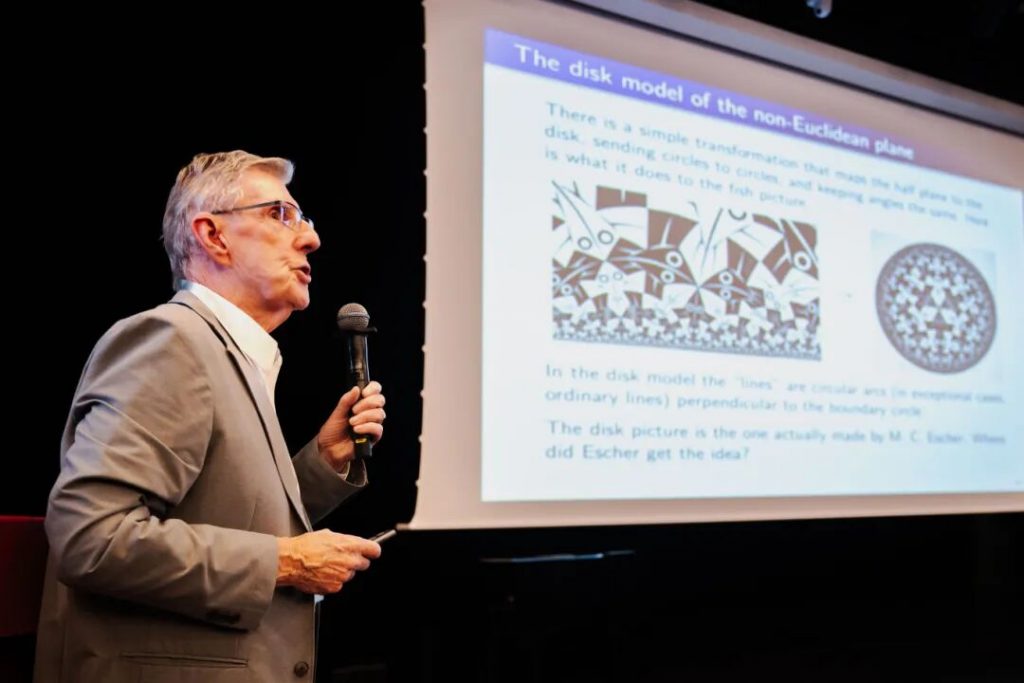
From the half-plane model to the disk model, the professor also shared the beautiful intersection where mathematics met art. The mathematician Donald Coxeter provided the artist M. C. Escher with the idea of using the disk model of non-Euclidean geometry for his tiling, enabling Escher to create a classic artwork that accommodates infinite fish within a finite circular space. This piece perfectly captured the core characteristics of non-Euclidean geometry, allowing everyone to truly see the beautiful fusion of mathematical rationality and artistic aesthetics.
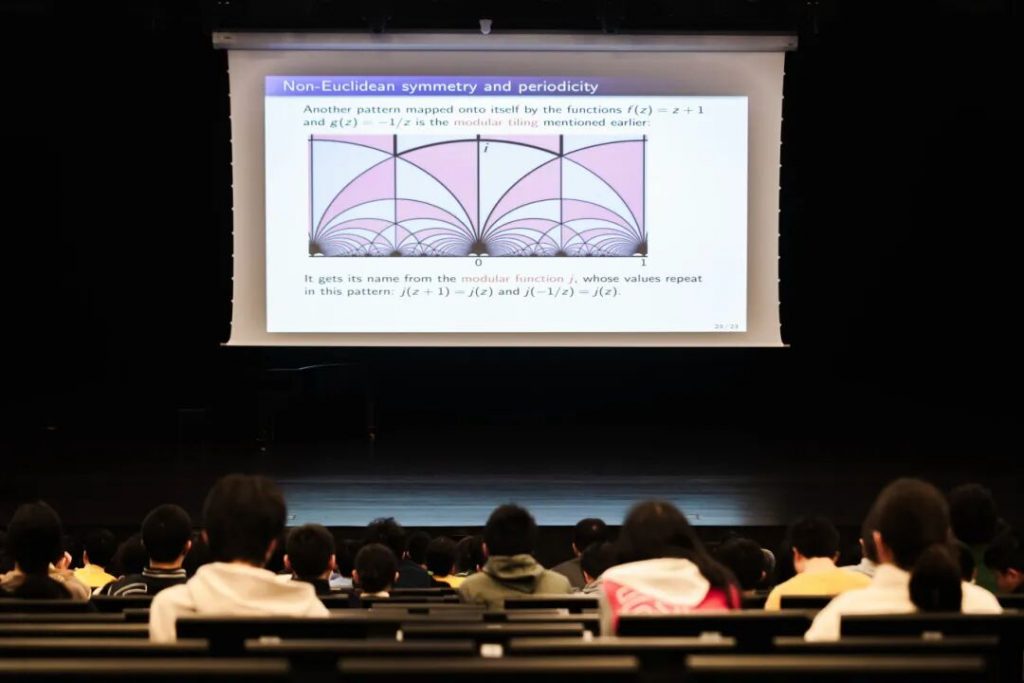
At the end of the lecture, the professor introduced the concept of complex numbers, using functions like z→z+1 and z→-1/z to demonstrate the self-mapping transformations of Ford circles and modular tiling patterns. The seemingly intricate symmetries and periodicities of non-Euclidean geometry could be precisely expressed through these simple complex functions. Furthermore, modular functions, as a vital starting point for modern pure mathematics research, clearly revealed to the audience the beauty of the progressive and interconnected layers of mathematical knowledge.


Starting from basic fraction arithmetic, moving through the geometric construction of Ford circles, into the fascinating world of non-Euclidean geometry, and finally reaching higher-level ideas like complex numbers and modular functions, the professor avoided long, complicated formulas. Instead, he built up the ideas step by step, starting simple and going deeper, helping the students see clearly that math is never just separate facts, but a connected and interesting whole.
Behind those unusual calculations and abstract geometric ideas, there are clever mathematical logics; and the beauty of math lies in starting from the simplest knowledge, always exploring the unknown, and finding surprises along the way.
- Article / Cynthia Chow
- Pictures / Vincent Yan