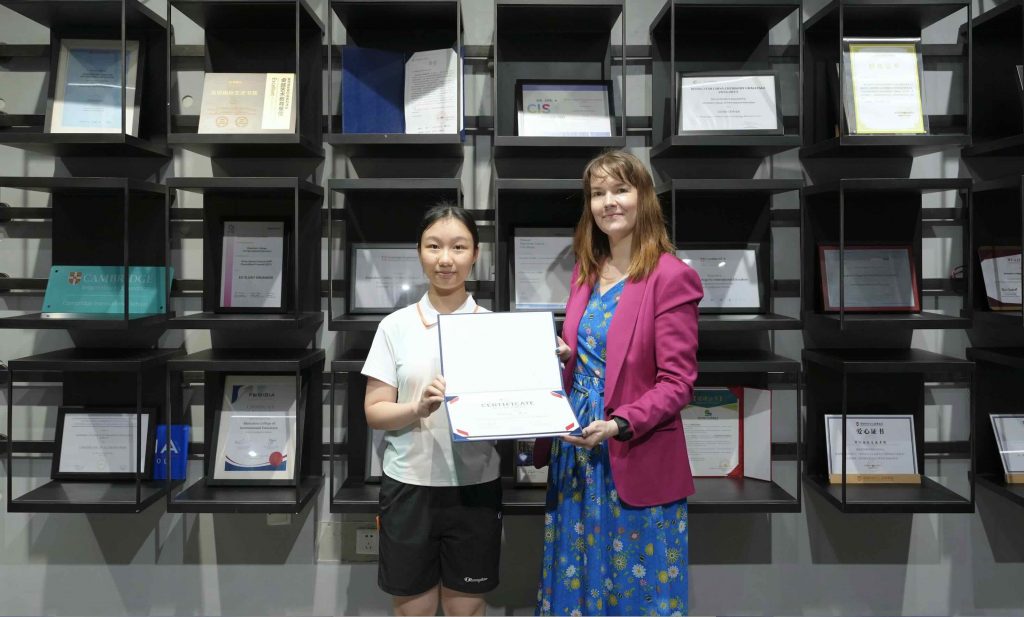
The Lumiere Competition has announced that Florence Xia, a G2 student at SCIE, has won a prestigious High Honors award and a $1,250 prize for her outstanding essay on the physics of turbulence. Her achievement places her among eight prize winners selected from over 2,100 entries submitted from more than 104 countries worldwide.
Yiwen chose to write on the challenging task: “Which problem of turbulence is the great problem of turbulence?” Her essay, titled “Turbulence: a persistent problem”, argues convincingly that the greatest challenge of turbulence is not merely its mathematical complexity, but the web of interdependent factors-economic constraints, hardware limitations, and climate change-that together hinder real-world innovation.
The Lumiere Competition, known for attracting young scholars from across the globe, received over 2100 submissions in 2026. To secure one of only eight prizes is a remarkable feat, reflecting exceptional analytical skill and original thought.
Winning essays were judged by an esteemed panel of professors from Oxford University, Cambridge University, Brown University, Dartmouth College, Duke University, Cornell University, Carnegie Mellon University, NYU, and Imperial College London.
Excerpt from Yiwen Xia’s winning essay
“Climate change is set to increase meteorological phenomena that cause turbulence, hence posing challenges to communication and flight safety… Increased turbulence in the atmosphere would make altering flight paths to avoid encounters more difficult… This creates a cycle of interdependent problems, where climate change poses need of improvement of technologies, which in turn, reveals other pressing problems of turbulence. As a result, each problem of turbulence must be addressed together. While innovation of algorithms and hardware relies on experts, reducing the impact of climate change requires wider actions of each individual.”
Interview with Yiwen
Q1. What first drew you to the topic of turbulence, and why did you choose to write about it for the Lumiere Competition?
A: What drew me to this prompt in particular is that it is a very open question. It provides a wide range of possibilities in terms of framing the central argument and deciding what factors to take into consideration. Turbulence itself is also a fascinating phenomenon, which connects to the major that I intend to study in university. So I chose this topic as it promised an enriching process of research and helps me learn more about the fields that I would be studying in the future.
Q2. Looking back, what was the most challenging part of researching and writing your essay, and what moment made you feel it was all worth it?
A: The greatest challenge for me would be the editing stage. After a few rereads of my essay, I found that the argument I had clearly formed in my brain does not translate well into written language. The process of fixing these subtle clarity issues was very challenging for me because I’ve never done such intense editing before. But after I submitted my essay, I felt that it was all worth it, because even if my essay was not perfect, I still gained a valuable experience which I can reflect upon.
Q3. For students considering applying to the Lumiere Competition in 2027, what advice would you give them about choosing a question, conducting research, or staying motivated through the writing process?
A: From my experience, I think the most important advice that might sound cliché would be to start early and manage your time wisely. I had the misconception that research would take the most time, so I delayed my writing process to read through a wide range of sources. When I finally started writing in the last few days before the deadline, I found the time I had was not enough and had to rush through the editing stage. Starting early also allows you to step away from your work so you can come back with a fresh perspective, as staring at your essay for an extensive period will likely make you lose motivation due to exhaustion.
Q4. Winning one of only eight prizes from over 2,100 entries across 104 countries is an extraordinary achievement. What do you think sets your essay apart, and what did you learn about yourself as a scholar through this experience?
A: I think what sets my essay apart is my attempt to adopt an interdisciplinary perspective. I chose to discuss factors that are not often explicitly connected to the problem of turbulence, adopting a systems-based viewpoint instead of focusing on one factor. Through this experience, I learned a lot about myself, including my most effective methods to absorb knowledge under time constraints. I also identified my weaknesses, for example, I need to improve my academic English for clearer expression in future essays.
All at SCIE extend their warmest congratulations to Florence for this extraordinary accomplishment!
- Article / Ms. Nicole